Potassium chloride KCl - the bond of potassium and chlorine. It is the third-lightest halogen and is a volatile red-brown liquid at room temperature that evaporates readily to form a similarly coloured vapour.
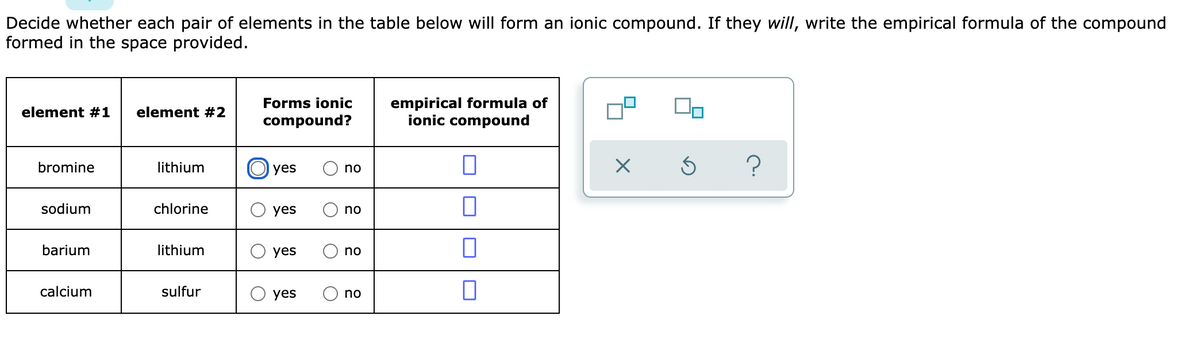
Answered Empirical Formula Of Ionic Compound Bartleby
Plutonium for instance has five giving it the ability to form an unusually wide range of compounds that scientists are only just beginning to get to grips with.
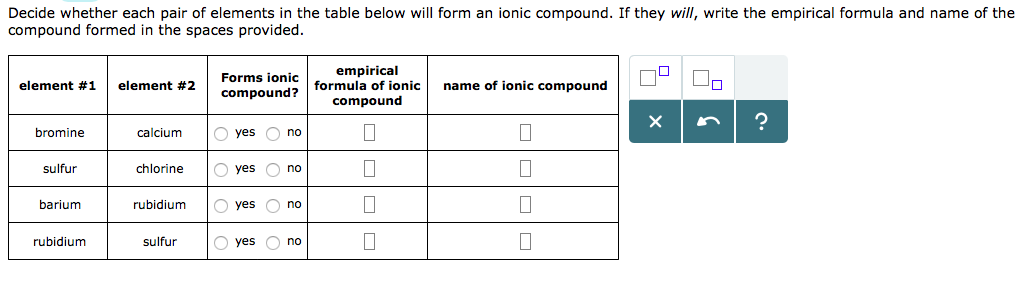
. Sodium chloride is created when sodium and chlorine create an ionic bond to become a crystal that tastes great on food. Chlorine doesnt normally react with oxygen. However in the presence of UV light chlorine can react with oxygen or ozone molecules to form the chlorine monoxide free radical.
Chlorine will displace the bromide ions to form sodium chloride and bromine. Potassium bromide KBr - potassium and bromine bonded. It is commonly referred to as goldIII bromide gold tribromide and rarely but traditionally auric bromide and sometimes as digold hexabromide.
If the negative ion is a compound ion eg NO 3 SO 4 2 CO 3 2 then. GoldIII bromide is a dark-red to black crystalline solid. Like all radicals this.
Bromine is a chemical element with the symbol Br and atomic number 35. They were given the name halogen from the Greek roots hal- salt and -gen to produce because they all produce sodium salts of similar properties of. Some say that plutoniums an evil element created by man but its actually a natural element produced by a process known as nucleosynthesis which takes place in supernova explosions when dying stars blow.
Halogen any of the six nonmetallic elements that constitute Group 17 Group VIIa of the periodic table. If the negative ion from the ionic compound is simple eg Cl or Br then that element is produced. The halogen elements are fluorine F chlorine Cl bromine Br iodine I astatine At and tennessine Ts.
Its properties are intermediate between those of chlorine and iodineIsolated independently by two chemists Carl Jacob Löwig in 1825 and Antoine Jérôme. This is an example of a redox reaction that forms an ionic compound. It has the empirical formula AuBr 3 but exists primarily as a dimer with the molecular formula Au 2 Br 6 in which two gold atoms are bridged by two bromine atoms.
Reaction of chlorine with oxygen. Potassium fluoride KF - the ionic bond of potassium and fluorine.
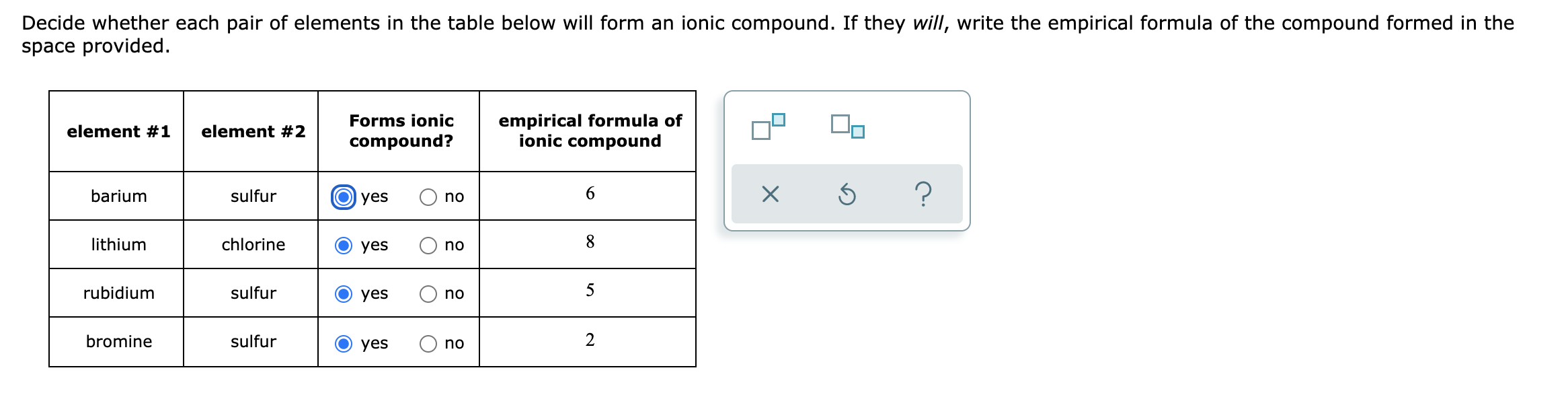
Answered Decide Whether Each Pair Of Elements In Bartleby
Solved Decide Whether Each Pair Of Elements In The Table Chegg Com
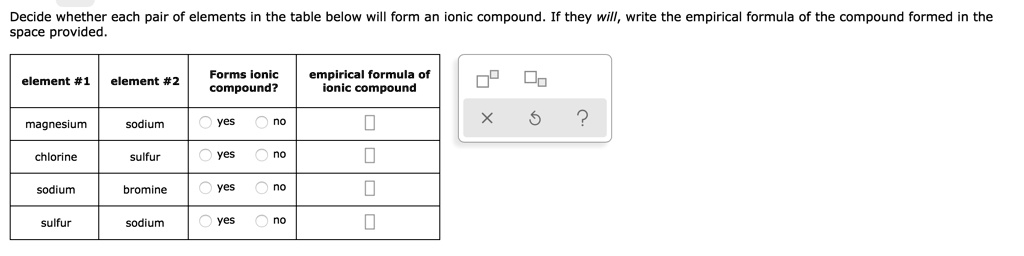
Solved Decide Whether Each Pair Of Elements In The Table Below Will Form An Ionic Compound If They Will Write The Empirical Formula Of The Compound Formed In The Space Provided Forms Ionic
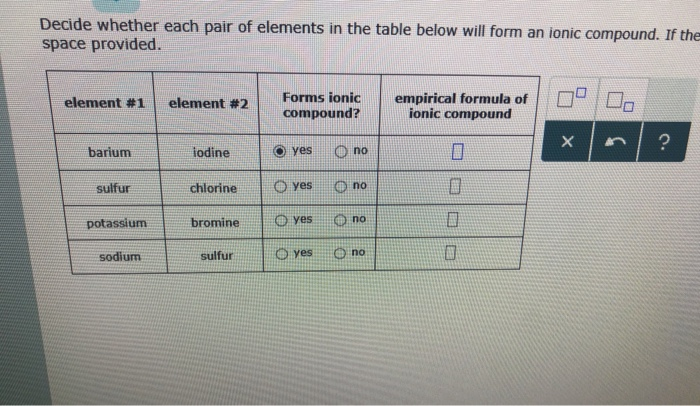
Solved Decide Whether Each Pair Of Elements In The Table Chegg Com



0 Comments